
A Network of Resilience Hubs Across Issaquah
Imagine a place in our community that not only supports residents but also acts as a hub for coordinating communication, distributing resources and reducing carbon pollution—all while enhancing everyone’s quality of life. That’s what the Urban Sustainability Directors Network (USDN) calls a resilience hub.
These hubs provide an opportunity to strengthen community resilience, manage emergencies, tackle climate change and promote social equity. They empower people to become more self-reliant, connected and successful before, during and after disasters or challenges.
In fall 2023, the City of Issaquah formed a team to develop a resilience hub strategy that would serve Issaquah residents. Under the leadership of Sustainability Coordinator David Reedy, the team brought together city staff from emergency services, administrative services, parks and community services, and communications. They also collaborated with community partners such as Issaquah School District, Eastside Fire & Rescue, King County, The Circle, Issaquah Food & Clothing Bank, King County Library System and Highlands Council.
Throughout this year, the team has worked through the following steps:
- Determine how a resilience hub (or hubs) best serve the residents of Issaquah?
- Establish criteria for what Issaquah resilience hubs should be.
- Select initial resilience hub locations and conduct assessments.
The team first determined that Issaquah would be best served by a network of resilience hubs, rather than a single location. Next, the team decided what features were important for a resilience hub. The top items on the list included:
- A welcoming and trusted community space that can transition to a resilience hub with limited effort.
- Safe and accessible infrastructure.
- Ability to operate successfully in an emergency.
We’re excited that Blakely Hall was selected as one of the city’s initial resilience hub locations, along with Issaquah Senior Center and Issaquah Food & Clothing Bank.
Key Priorities for the Blakely Hall Resilience Hub
The Blakely Hall Resilience Hub Task Force—comprised of residents, CERT volunteers, Highlands Council staff and city employees—is actively developing an operating plan to guide emergency services at Blakely Hall.
In addition to finalizing the plan, we’re currently focused on three key priorities:
- Establishing resilient power. We are working to have generator power available during power outages, so Blakely Hall can remain a reliable resource when it’s needed most.
- Building and training a volunteer team. In an emergency, staff may not always be available, so we’re assembling a team of trained volunteers ready to assist the community at Blakely Hall. Interested in joining? Reach out to me at lindsey.p@ihcouncil.org.
- Stocking emergency supplies. We are gradually building a supply of essential items to meet the community’s most urgent needs during a crisis.
As this initiative progresses, we’ll continue to share updates on the services you can expect from the Blakely Hall Resilience Hub in an emergency. Stay tuned—and thank you for being part of a more prepared and connected community!
Crisis Ready: How Blakely Hall Supports You
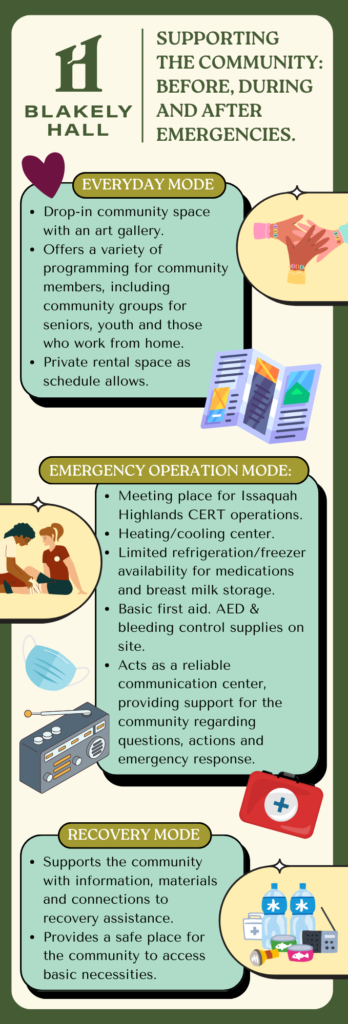
As a resilience hub, Blakely Hall is preparing to support community members before, during and after emergencies.
These operation modes are vital for fostering community resilience, keeping residents connected with each other and essential services, and ensuring they are prepared for potential emergency situations.
See the graphic at left for Blakely Hall’s different modes of operation as a resilience hub.
Functions will shift depending on needs at the time. On a typical day, Blakely Hall offers a community space with an art gallery and an assortment of events and community groups for community members of all ages, ranging from Co-Working Group to the popular Issaquah Highlands LEGO™ Expo. On weekends, when not hosting community events, Blakely Hall is rented out for private parties and events.
When the resilience hub is activated in an emergency, Blakely Hall will serve as a safe place for residents to get information, limited medical supplies and some basic services. It can act as a heating and cooling center during extreme weather events and remains equipped with basic first aid, bleeding control supplies and an AED for people experiencing sudden cardiac arrest. It will also serve as a meeting place for Issaquah’s Community Emergency Response Team (CERT) operations.
During recovery mode, Blakely Hall will support the community by continuing to offer a safe place for those who need it, as well as providing connections to information, assistance and basic necessities.
Moving forward, we hope to expand Blakely Hall’s resilience hub features to offer additional services and community support. Our goals for the future include:
- Develop and implement ongoing community education on preparedness.
- Acquire supplies to support the community in case of emergency, including communication tools, chargers and basic medical supplies.
- Develop and communicate an emergency operations plan for staff, local CERT members and the Issaquah Highlands community.
- Pursue funding for solar power and backup battery storage to ensure a reliable and resilient power system, even during lengthy power outages.
- Establish a plan for overnight sheltering and acquire necessary equipment.
Embracing a Whole-Community Approach
Highlands Council is prioritizing a “whole-community” approach to improving safety and resilience through community preparedness in the coming months.
The Federal Emergency Management Agency (FEMA) defines the whole-community approach to preparedness as “a means by which residents, emergency management practitioners, organizational and community leaders, and government officials can collectively understand and assess the needs of their respective communities and determine the best ways to organize and strengthen their assets, capacities and interests. By doing so, a more effective path to societal security and resilience is built.”
In simpler terms, the whole-community approach helps to reduce our dependence on the government for help following a disaster by bringing together neighbors that are prepared and ready to help themselves and their neighborhoods in times of need.
Why is this important?
The Presidential Policy Directive on National Preparedness (dhs.gov) puts the responsibility for preparedness on each member of the community. That means that we, as residents and neighbors, are expected to be prepared for potential crises and are responsible for recovery efforts in case of an emergency.
What do we need to be prepared for?
As a community, we want to be prepared for everything–from a short-term power outage or helping a neighbor through a medical event, to a cyber-attack or large-scale earthquake. While we hope to never face a disaster, building strong relationships within our community enhances our resilience by developing social capital. In turn, studies have shown that increased social capital is good for our physical and mental health, resulting in longer, happier lives!
By embracing the whole-community approach, Highlands Council is committed to understanding and addressing the actual needs of Issaquah Highlands residents. We’re actively engaging and empowering everyone involved in the community, while also reinforcing the strengths that make our daily lives better. We are stronger together!
As a resilience hub, Blakely Hall perfectly aligns with this approach by providing a shared safe space for education, communications and recovery.
Lindsey Pinkston is the Highlands Council executive director and a Wisteria Park resident. She is also a CERT Team 9 member.