Building Community Resilience Through Preparedness
By Lindsey Pinkston, Highlands Council Executive Director
While it may feel uncomfortable to think or talk about emergencies, the reality is that they happen—and often without warning. From natural disasters and accidents to acts of terrorism, emergencies can come in many forms.
Ignoring this truth doesn’t make it go away. In fact, it can increase the likelihood of harm and the severity of the consequences that follow.
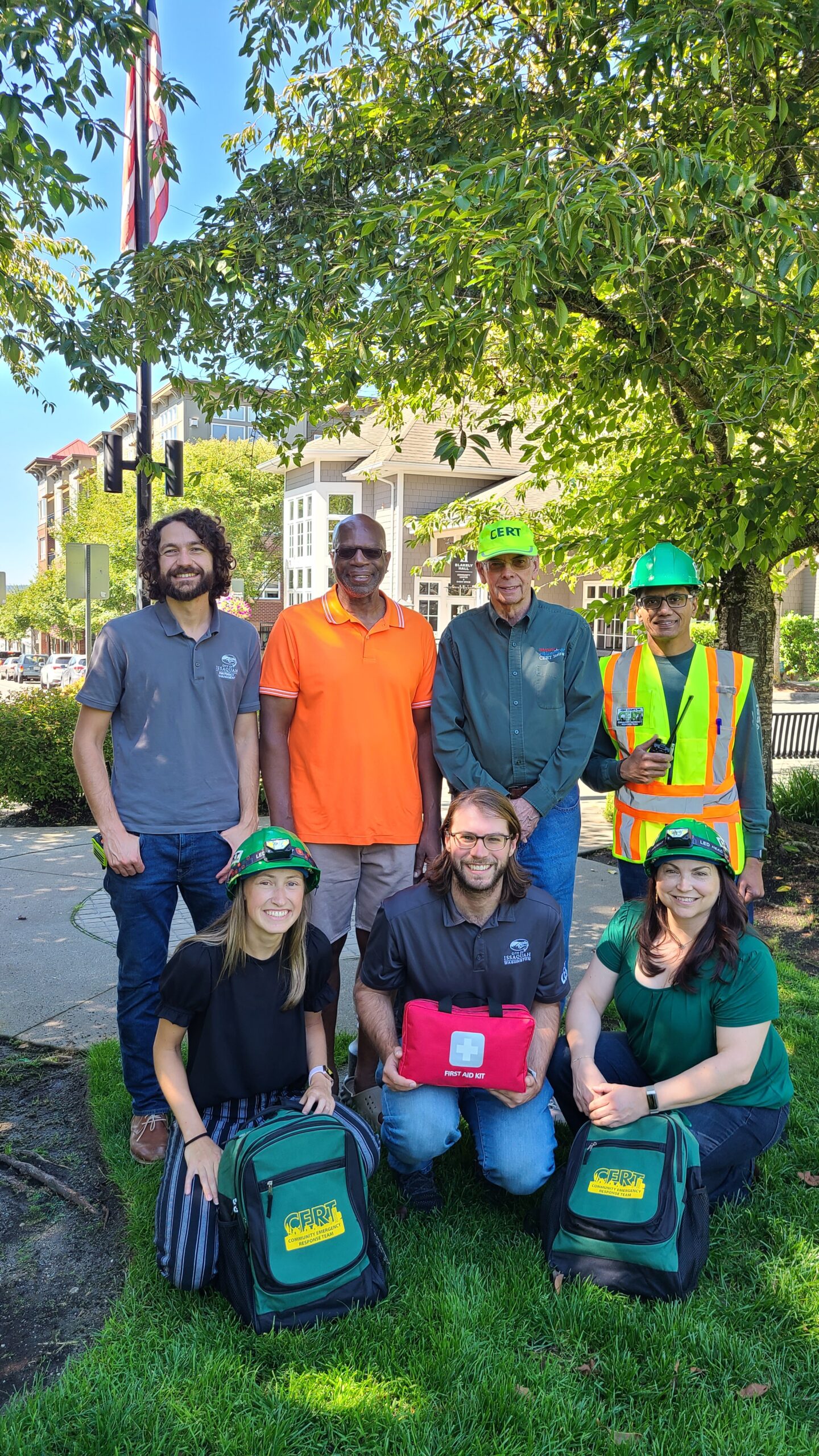
Resident volunteers, CERT members and city staff have joined forces to keep Issaquah Highlands prepared for emergencies.
The good news? We can take meaningful steps—individually and as a community—to reduce the damage and discomfort that disasters bring, whether large or small.
According to FEMA’s National Risk Index, King County faces an exceptionally high risk of natural hazards—99.7%. Our greatest vulnerabilities stem from earthquakes, landslides and volcanic activity.
What does this mean for us? It means we must continue working together to strengthen our community’s resilience. FEMA defines community resilience as “the ability of a community to prepare for anticipated natural hazards, adapt to changing conditions, and withstand and recover rapidly from disruptions.”
There are many ways to get involved. You might attend our Are You Ready? Workshop Series, join Issaquah’s Community Emergency Response Team (CERT), serve as a Resilience Hub volunteer, or simply begin preparing at home. Whatever path you choose, I encourage you to take small steps each month to build your readiness for whatever may come.
Even a basic power outage can be disruptive and uncomfortable. With a little preparation—like knowing how to stay connected to the internet, manually open your garage door, and having supplies for comfort and entertainment—you can maintain a sense of normalcy (right down to your daily cup of coffee). In the face of larger disasters, like a major earthquake, those same preparations could be life-saving.
Let’s build a culture of readiness—because community resilience starts with each of us.
Prepared Together:
Progress at the Blakely Hall Resilience Hub
The Blakely Hall Resilience Hub Task Force—comprised of residents, CERT volunteers, Highlands Council staff and city employees—is actively developing an operating plan to guide emergency services at Blakely Hall.
In addition to finalizing the plan, we’re currently focused on three key priorities:
- Establishing resilient power. We are working to have generator power available during power outages, so Blakely Hall can remain a
reliable resource when it’s needed most. - Building and training a volunteer team. In an emergency, staff may not always be available, so we’re assembling a team of trained
volunteers ready to assist the community at Blakely Hall. Interested in joining? Reach out to me at lindsey.p@ihcouncil.org. - Stocking emergency supplies. We are gradually building a supply of essential items to meet the community’s most urgent needs
during a crisis.
As this initiative progresses, we’ll continue to share updates on the services you can expect from the Blakely Hall Resilience Hub in an emergency. Stay tuned—and thank you for being part of a more prepared and connected community!
Preparedness Resources at Your Fingertips
By Maddie Coats, Highlands Council Communications Manager
Issaquah Highlands offers incredible access to nature and city life, but living near the mountains and a big city means preparing for a wide range of emergencies.
Our region faces a wide range of potential emergencies, from everyday disruptions to large-scale disasters. While some events may only last a few hours, others can have longer-lasting impacts on our homes, health, and daily routines.
Some emergencies are seasonal and familiar, such as summer heat waves, winter freezes, smoke-filled skies and power outages. These situations can disrupt daily life and, if prolonged, pose real health and safety risks. Knowing what to expect and how to respond can make all the difference in staying comfortable and safe during these events.
Beyond these short-term challenges, our community also faces the possibility of more serious disasters such as earthquakes, wildfires, landslides or potentially acts of violence. While these incidents are less frequent, they have the potential to cause widespread damage and require neighbors to rely on one another.
Considering the various risks of short- and long-term emergencies, Blakely Hall is preparing to serve as a safe and supportive hub for residents. When activated as a Resilience Hub, the community center plans to offer tools and resources, refrigeration for medications and breast milk, charging stations and WiFi, community engagement, basic first aid, emotional support and more.
While we’re taking steps to use Blakely Hall as a resource for emergencies, Highlands Council is launching a monthly Are You Ready? Workshop Series. The series will cover topics related to household emergency planning, basic disaster medical, emergency kits, fire safety and much more. Join us at Blakely Hall on the first Thursday of every month from 6:30-8 p.m. The following events are free and open to the public.
View the full lineup of emergency preparedness workshops.
Explore Our Emergency How-To Guide
Learning never stops, and that includes staying prepared for emergencies. It’s never too late to educate yourself on how to keep your family and community safe, and in today’s world, the resources you need are right at your fingertips.
To make it easy, we’ve launched a new online resource featuring a comprehensive Emergency How-To Guide. Explore the webpage to find step-by-step instructions for essential skills like filtering water, using a generator safely, signing up for emergency alerts, using your WiFi in an outage and more. The webpage also includes detailed information about local hazards, evacuation routes, and a wealth of other resources to help you feel confident and ready no matter what comes our way.

CERT volunteers practiced fire safety during the Issaquah Highlands spring 2025 course.
Invest in Resilience:
Join an Upcoming CERT Program
The Issaquah Community Emergency Response Team (CERT) plays a vital role before, during and after disasters by stepping in where help is needed most.
Volunteers are trained to check on neighbors, share important information, support emergency operations, and assist with tasks such as traffic and crowd management. Through CERT, everyday community members gain the skills to support their families, coworkers and neighborhoods in times of crisis.
The CERT Basic Training program follows FEMA’s national curriculum, giving participants hands-on experience with essential disaster-response skills. This includes what to do when professional emergency services are delayed or unavailable. With practice and teamwork, CERT members are prepared to protect themselves while helping the greatest number of people during an emergency.
The course is offered for free multiple times each year in Issaquah. Every spring and fall, the class is held at Issaquah Public Works. This January, we’re excited to offer CERT Basics at Blakely Hall. Information on all courses is available at issaquahcert.org.
The January training will take place over two weekends, with classes held at Blakely Hall on Jan. 23, 24 and 31 from 9 a.m. to 5 p.m. The final drill will take place on Sunday, Feb. 1. Attendance at all sessions is required to graduate.
Our free CERT Basic Training requires an application to register, with priority given to Issaquah residents. Youth ages 13–17 may participate with written parental consent, while children 11–12 may attend if accompanied by a parent or guardian.