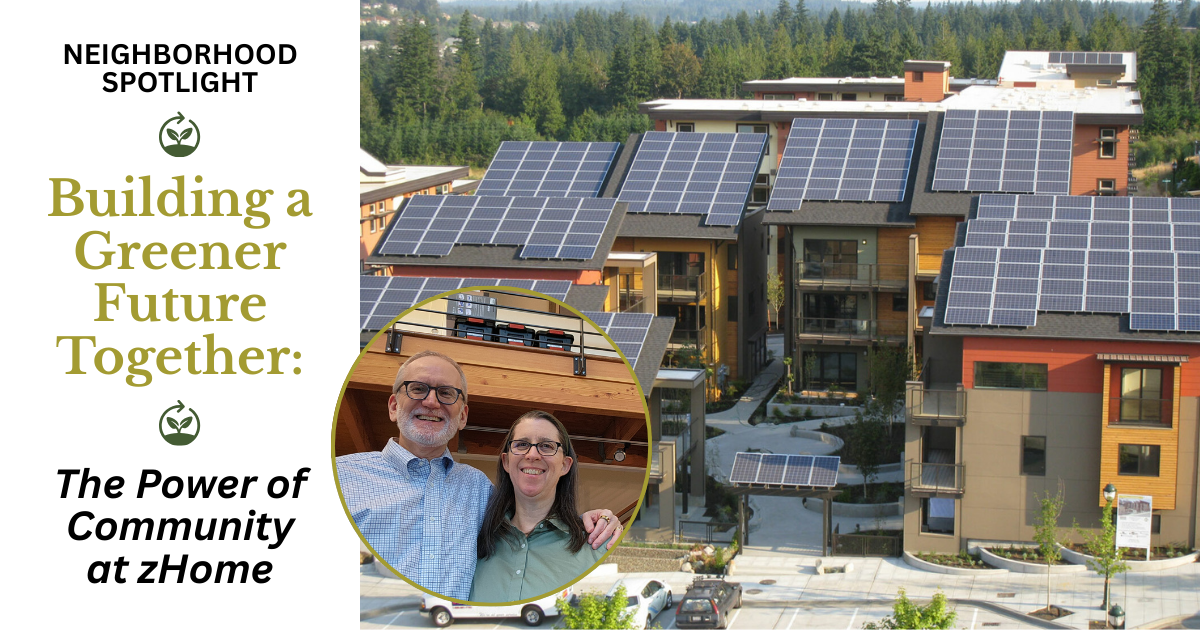
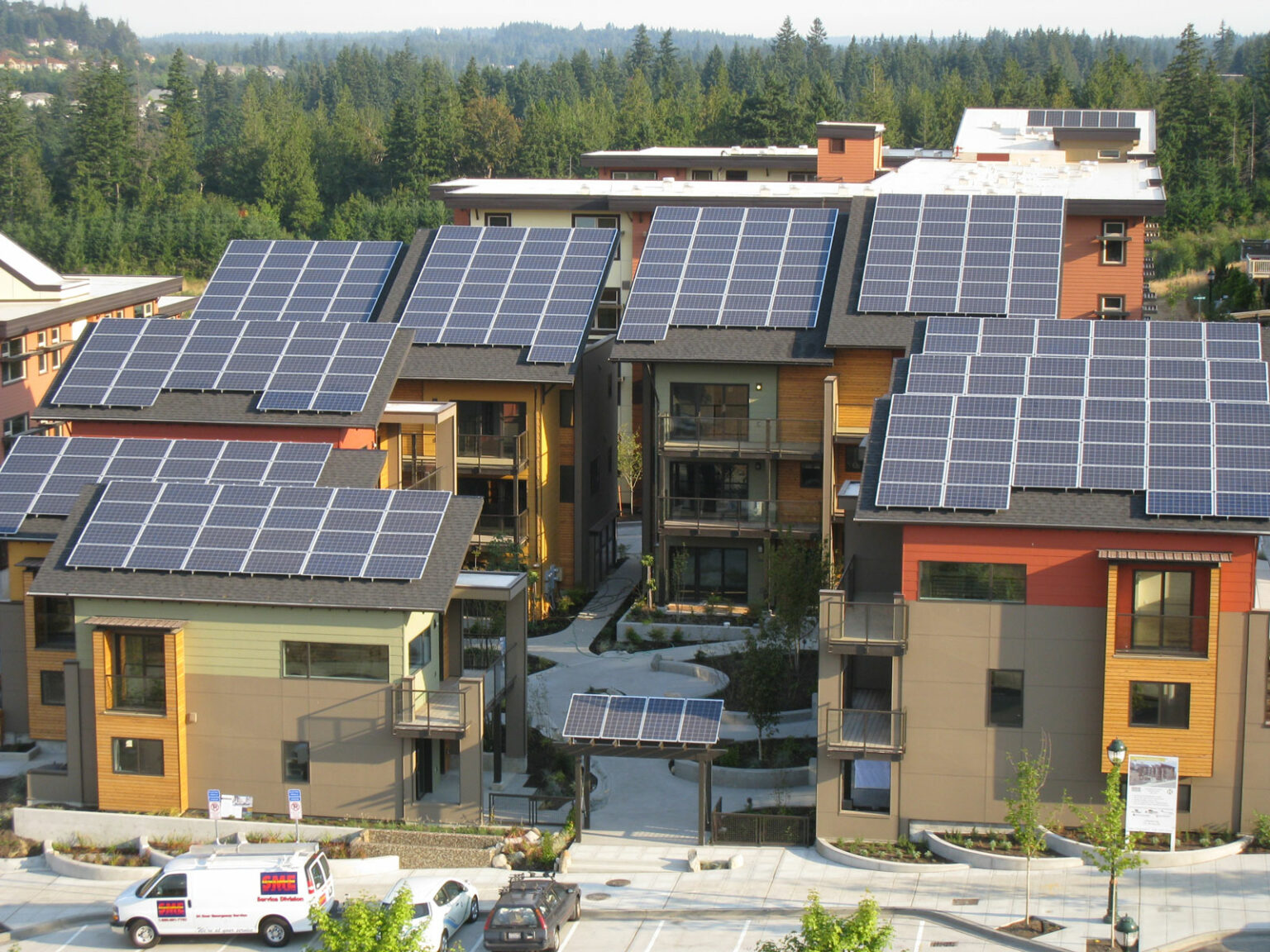
The zHome community was designed as a groundbreaking model to inspire the housing industry toward a more sustainable, climate-friendly future.
My wife, Karin, and I are homeowners in the zHome neighborhood in Issaquah Highlands. Our little neighborhood is easy to spot. Located behind the movie theater, it’s a collection of 10 three-story townhomes with solar panels covering our roofs. The homes are huddled around a lush green courtyard. If you wander in (and we hope you do), you’ll notice several signs describing the features of our homes. Why would a neighborhood have such signs?
The zHome neighborhood was built to drive the housing industry toward more climate-friendly homes while keeping them comfortable and affordable for everyday buyers. The project was led by the City of Issaquah with a coalition of groups including Puget Sound Energy, King County, Built Green, Ichijo USA and Port Blakely Communities (developer of Issaquah Highlands).
Completed in 2011, zHome is the first net-zero energy townhome development in the U.S., producing as much energy as it consumes through solar panels.
You might think that the people who live in the zHome neighborhood are just a bunch of rich, geeky environmentalists. Nope. Proving the neighborhood’s purpose, the homeowners here are just people with typical means who want a comfortable place to live.
For Karin and me, environmental concerns were not high on our list of requirements for purchasing a home. We had settled on Issaquah Highlands because we liked its “urban village” ethos, which combined many of the advantages of both city and suburban living while avoiding their drawbacks. In a home, our primary concerns were affordability, new construction and avoiding the drawbacks of apartment-dwelling. We only discovered the zHome neighborhood by accident one day while taking a walk and stumbling across those courtyard signs.
The signs describe the assortment of technologies that zHome employs to keep energy use low enough to hit that zero net-energy mark. Here are a few highlights. First, the buildings themselves are heavily insulated and airtight. The walls are so thick that the windowsills are over 8 inches deep. To our two black cats, Othello and Zora, that’s just perfect for sunning. Because the buildings are airtight, they require ventilation. A heat-recovery ventilator heats incoming fresh air by passing it near outgoing warm air. Combined with insulation, this keeps our homes warm and comfortable.
The remainder of the work in heating our homes is accomplished by our geothermal heat pumps. The heat pumps supply 115°F hot water that circulates beneath our floors, which radiates up the walls and throughout our homes. Our heat pumps also heat our tap water. The heat source for our pumps is a closed loop of water that flows through fifteen 220-foot-deep boreholes beneath our neighborhood. The temperature underground remains a constant 51°F no matter how cold it gets outside. Our heat pumps must only make up the difference between 51° geothermal water and the 115° hot water used in our homes.
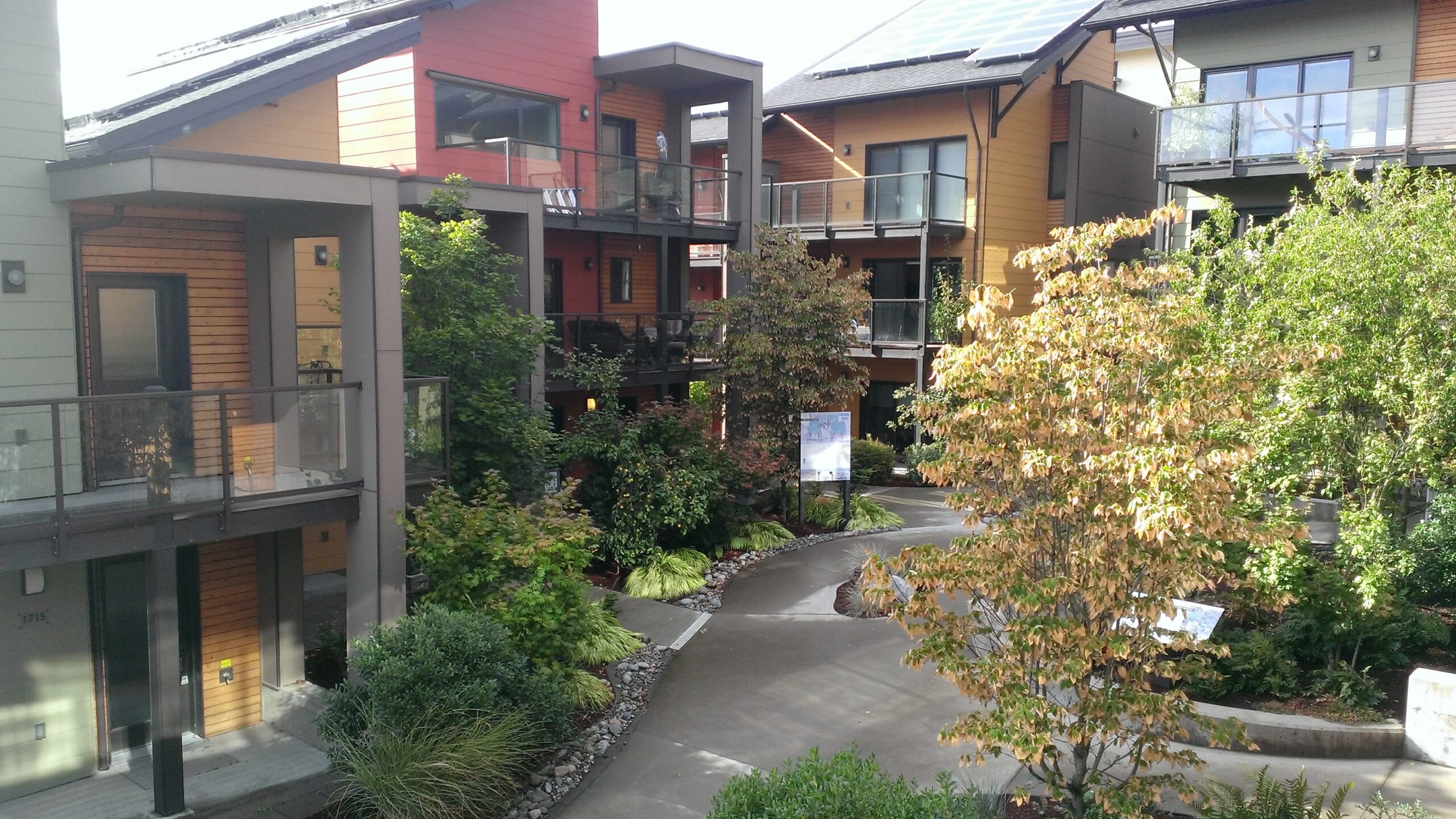
The zHome neighborhood was built not only to conserve energy but also water. Our homes include a rainwater system that supplies rainwater to our toilets, clothes washers and outdoor hoses. Rainfall runs from our roofs down gutters into 1,700-gallon underground cisterns that store rainwater for later use. The rainwater is filtered to keep it clean (though not drinkable).
In addition, all our faucets and shower heads are low flow. Also, our landscaping has no sprinklers. Instead, our yards are populated with plants that require little extra watering.
The townhome layout includes a loft bedroom overlooking a living room with high ceilings. In the summer, we enjoy covered wooden decks overlooking our green courtyard and easy cooling using the stack effect at night—we open our bottom-level windows to let in the cool air and our top-level clerestory window to exhaust the warm air.
As a demonstration of climate-friendly housing, our neighborhood has drawn a fair amount of attention over the years. We sometimes see school and conservation groups touring our courtyard with hosts explaining the technologies.
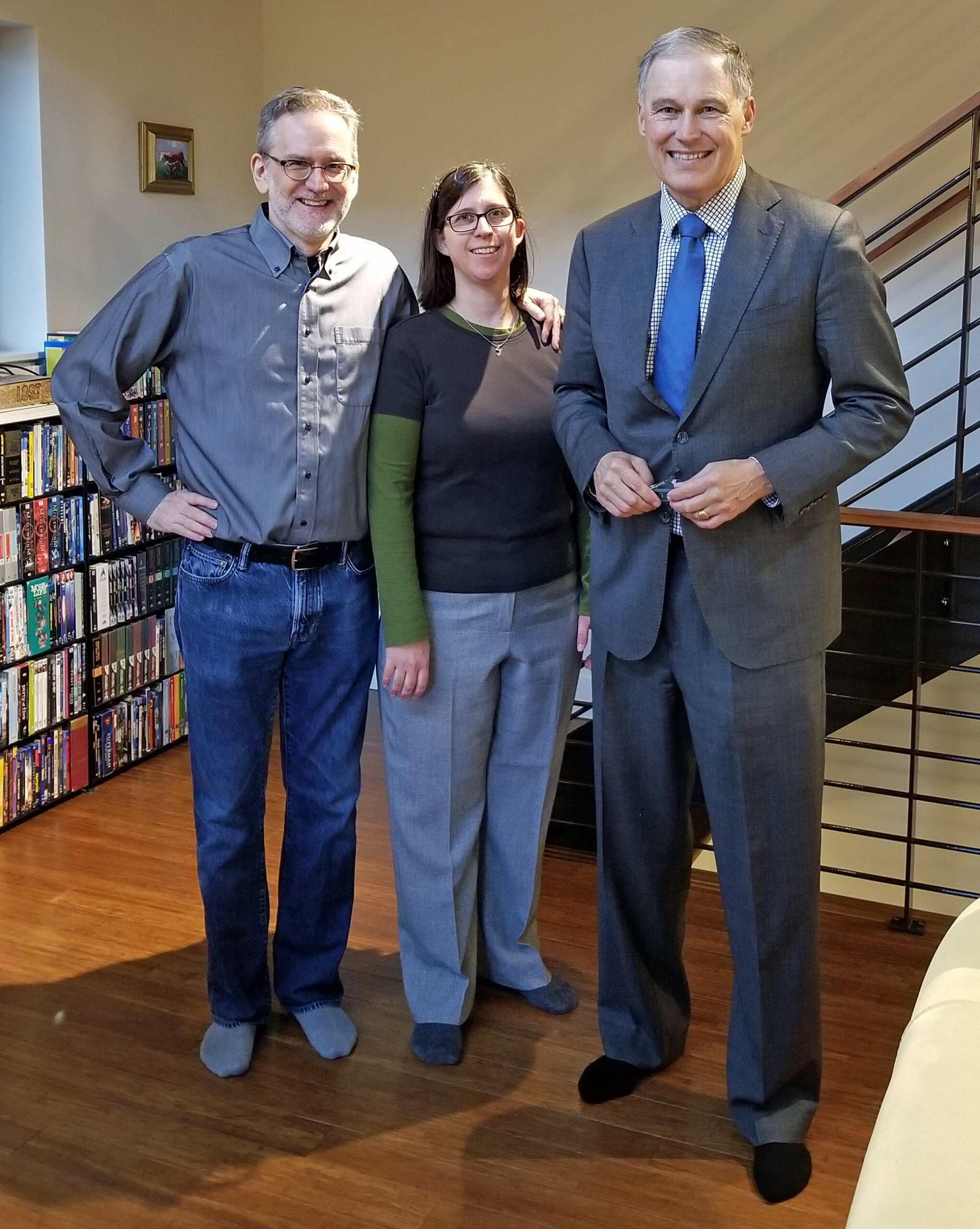
Former Washington State Governor Jay Inslee toured the zHome development in 2018.
Inside our home, Karin and I have voluntarily hosted a tour for a Japanese architectural group, an elementary school and a robotics group. In 2018, we had the honor of hosting a special visit by Washington State Governor Jay Inslee along with Issaquah Mayor Mary Lou Pauly.
Best of all, our shared resources—like the geothermal loop and nearly identical solar and rainwater systems—foster a strong sense of community. I maintain a neighborhood email alias that we frequently use to discuss issues, questions and solutions. We also sometimes coordinate maintenance visits for our entire neighborhood, securing lower rates.
One of our long-time homeowners, Gordon, noticed some pipe corrosion in the outdoor shed that houses our shared geothermal pumps. So, one afternoon about five of us met at the shed and worked together to remove some obstacles that were trapping condensation. We also installed a dehumidifier. We came together as a community and solved our problem!
Bryan Bell is a resident of the zHome community.
As published in the spring 2025 issue of Community Connect >>>